Pricing & RGM AI Agents: The Analyst Work, Done by Agents Your Team Governs

If your team spends more time wrangling numbers than making decisions, you're not alone. We build AI agents that handle the heavy lifting: promotion post-mortems, price-change recommendations, margin leakage checks, planning workbooks, and Monday commentary. Your team stays in the driver's seat for every decision. The agents run in your environment, on your data, co-designed with your team and fully owned by you. The payoff? One AI-fluent pricing manager, upskilled by us, can now do the work that used to require three hires.

3 to 1
Three analyst roles’ work, one AI-fluent pricing manager
90–120 days
First agent live in your environment, with approval gates
200–400 bps
Typical year-one gross profit when the pricing layer is in scope
 
Every decision
Approved by your people, logged, and auditable
 

The problem

Your pricing team is an assembly line for spreadsheets

In most mid-market companies the pricing and RGM analysts spend roughly 70% of their time assembling the picture and 30% acting on it. Eight tabs open on Monday morning. A promotion post-mortem that takes two weeks, so it never gets done. Elasticities refreshed once a year. A head of RGM who is the bottleneck because every question takes hours to answer. Hiring out of it is slow and expensive, and the new analyst inherits the same tabs.

Here’s the hard truth: most AI projects in commercial teams never make it to production. Gartner predicts over 40% of agentic AI projects will be cancelled by 2027, usually because the data foundation, governance, or business case just isn’t there. The ones that succeed have three things in common: they run on reconciled data, operate within guardrails your company sets, and always require a human sign-off. That’s exactly how we build them.

What you get

Six jobs your team stops doing by hand

Every agent is designed to take on a real job your analysts do today, using your data and tested against your team’s actual past decisions before it ever goes live. Start with the agent that delivers the fastest payback. Once your team trusts it, add the next. Build momentum, one quick win at a time.

Promotion Optimization Agent

The work of a promotion-optimization analyst.

Scores every planned event before it runs (baseline, lift, cannibalization, ROI after funding), watches in-flight events and flags underperformance by day three, runs the post-mortem the week the event ends, and drafts the calendar changes for the monthly promotion review. Writes the approved changes back to your trade promotion management tool.

Price-Change Recommendation Agent

The work of a pricing analyst.

Now, elasticities refresh automatically as new data comes in. The system pinpoints which SKUs, customers, and channels can absorb a price increase without sacrificing volume. It checks your competitive price position and prepares each recommendation with supporting evidence. Your pricing manager reviews and approves; your agent simply prepares the price file. No more guesswork, just actionable insights.

Scenario and Strategy Agent

The work a pricing strategist does between strategy cycles.

Runs scenarios on list-price moves, pack-price architecture, channel policy, and cost pass-through; stress-tests every proposal against your elasticity guardrails; and returns increase, hold, or monitor, with the reasons. It also tells you when not to act.

Margin Leakage Monitor

The work of a sales-finance analyst and a deal desk.

It continuously checks the price waterfall (taking into account off-invoice discounts, rebates, allowances, freight, and payment terms), identifies any exceptions together with the accounts responsible for them, and puts together the weekly sales-finance review. In the B2B environment, the quotes are assessed against the discount guardrails included in your CPQ before the representative sends them.

Performance Commentary Agent

The Monday narrative, written before the meeting.

Reads the week’s price, volume, mix, and margin movements, explains what changed and why in plain business language, and proposes what to do next. Monthly business review preparation drops from days to minutes, and every number traces back to the source.

Planning Agent

The annual plan and key-account planning, without the formula errors.

Driver-based planning workbooks come preloaded with elasticities, depletions, and trade terms, so your team starts with the right data. Every scenario is checked against distributor margin, retailer margin, and volume guardrails, no more manual cross-checks. Plans roll up into your planning system automatically, eliminating re-keying errors. The result? Your key account managers spend the planning season selling the plan, not building it from scratch.

The operating model

One AI-fluent pricing manager instead of three hires

Your pricing team doesn't shrink. It levels up. When AI agents handle the manual assembly, scoring, and drafting, your pricing manager can finally focus on the decisions that actually move the needle: which price change needs a sales conversation, which promotion should be redesigned instead of recycled, and which customer terms need a fresh look. In our experience, one AI-fluent pricing manager, trained through our programs, can deliver the same impact as a three-person team. That means your next hire can focus on driving sales, not wrangling spreadsheets.

Fluency is the deliverable: knowing what the agent did, why, and when to overrule it. That is what we train.

Governance

The agents recommend. Your people decide.

AI-powered pricing without limits is a liability, not a feature. Every agent we build ships with the controls a CFO and a general counsel would ask for.

What Your Team Leaves With

Guardrails are built into the code. Margin floors, price ceilings, daily move caps, competitive index bands, and contractual escalators are enforced as hard rules. No recommendation gets through unless it passes every check, so you stay compliant and in control.

Confidence routing. Routine, in-guardrail recommendations go to your approver with a one-page evidence file. Low-confidence or strategic moves pause for review with the signals, the elasticity, and the rules they touch laid out.
Override capture means every approval, edit, or rejection is logged with the reason. This feedback goes straight into the next model refresh, so your agent learns your business judgment over time, instead of trying to replace it.
Audit trail is built in. Every input, model version, recommendation, check, approver, and final price is logged for every decision. So when a regulator, auditor, or retailer asks about a price move, you have the answer ready, no more last-minute scrambles.
Antitrust boundary. The agents use your data and public market data only. No competitor’s non-public data is ever ingested, and no pricing logic is shared across companies.
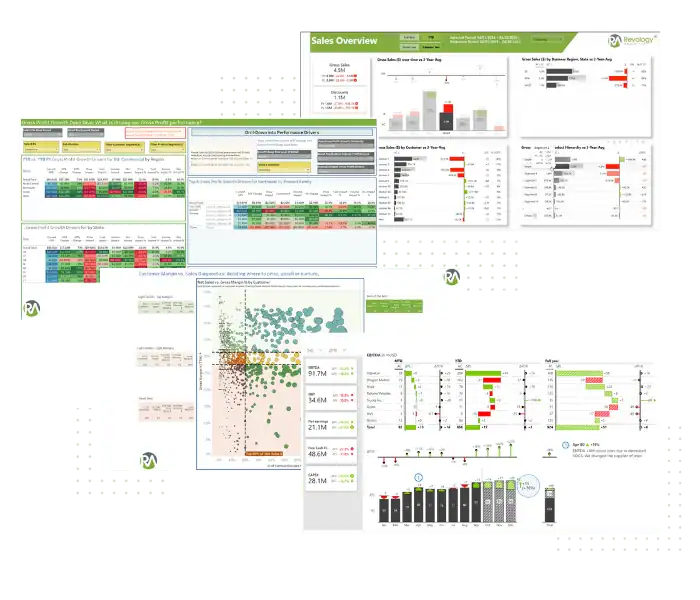
Business analytics dashboard with sales and revenue data visualization.

Where it runs

Agents are only as good as the numbers under them

If your data is fragmented or unreconciled, you’re setting your agents up to make fast, but wrong, decisions. That’s why every engagement starts with a single, unified commercial data model. We bring together ERP, point-of-sale, syndicated, promotion, distributor, and competitive feeds, all reconciled to your general ledger. We also build a semantic model so that every agent defines a customer, a promotion, and a margin the same way, no ambiguity, no surprises. If you already have this foundation, we move straight to deploying your first agent. If not, our Commercial Analytics Transformation team builds it with you, step by step.

The agents run inside your environment: your data warehouse, your BI tools, your security perimeter, and the AI models your company has approved (Claude, OpenAI, or your cloud provider’s). Nothing leaves your tenant. There is no Revology platform, no license fee, and no per-seat license. You own the prompts, the code, the evaluation suites, and the documentation, and your team is trained to run and extend them. If you would rather we keep the agents maintained and evolving, an optional managed-services agreement at a modest monthly fee covers that.

From no agents to an agent in production in one engagement

  1. Assessment (Weeks 1–3): We start by mapping out which analyst tasks are repetitive, measurable, and close to a business decision. We check your data readiness and co-create guardrails with your pricing, finance, and sales leaders. The first agent isn’t chosen based on hype. It’s selected for maximum margin impact and data readiness. This is about practical wins, not chasing trends.

  2. Foundation. The governed data model, the semantic model, and the quality gates. Already in place at some clients; built as part of the engagement at most.

  3. First agent live. Built by our partners, co-designed with your team, evaluated against your analysts’ past decisions before it sees a live one, with the approval gates on from day one. Typically inside the 90–120 day engagement.

  4. Run and extend. Your team runs it. We train the AI-fluent pricing manager, add the second and third agents when the first has earned trust, and stay on call, or maintain it for you under managed services.
Business professionals discussing strategies with key stakeholders in a meeting.

One capability inside the end-to-end practice

Pricing & RGM AI Agents are a capability rather than a product; they are based on the data foundation of Commercial Analytics Transformation, fall within the strategy and governance of the Pricing & RGM discipline, and are passed on to your team via the Adoption & Execution layer as well as our corporate training programs. The agents enable a good pricing operating system to be developed more quickly, but they do not eliminate the need for such a system.

Frequently Asked Questions

Will AI agents replace my pricing team?

No, these agents don't replace your people. They replace the tedious assembly work, the scoring, and the first draft of the analysis. Your pricing manager can finally spend the week making decisions, not wrestling with spreadsheets. The next person you hire can focus on selling, not stitching data together. In our experience, clients run more analysis with less manual effort, freeing up your team for higher-value work.

What decisions do the agents make on their own?

None. They recommend, with the evidence attached, inside guardrails your company wrote. Your people approve, edit, or reject every recommendation, and every one of those actions is logged and feeds the next refresh. Where a client wants routine, in-guardrail actions to flow automatically (a clearance price inside a finance-approved floor, for example), that is a governance decision you make, not a default we ship.

What data do we need before an agent is useful?

Reconciled data. An agent needs one commercial data model (transactions, pricing, promotions, costs, and where relevant syndicated and distributor data) with shared definitions and a tie-out to the general ledger. If your data is fragmented, we build that foundation first through Commercial Analytics Transformation, and the first agent follows. Starting an agent on unreconciled data is how AI pilots fail.

Which AI models do you use, and where does our data go?

The models your company has approved: Claude, OpenAI, or your cloud provider's, running inside your tenant. Your data never leaves your environment, and nothing is used to train a model for anyone else. The deterministic math (elasticities, ROI, waterfalls) is code your team owns; the language model explains, drafts, and routes, and it is never the calculator.

How is this different from the AI features in pricing software?

Here's the difference: Vendor agents run on their platform, using their model of your business, and you pay a license fee. Our approach is different. Your agents run on your data model, inside your environment, with guardrails and approval gates you define. You own it, no license fee, no vendor lock-in. When your business changes (and it always does), you adjust the agent yourself. No support tickets, no waiting.

How fast is the first agent working?

Usually inside the 90–120 day engagement, and sooner when the data foundation already exists. The year-one value comes after that, from your team acting on the recommendations every week. Typical year-one outcome when the pricing layer is in scope: 200–400 bps of gross profit, and up to a 10–12% increase in operating profit dollars.

Has Revology been independently ranked?

Yes. Revology Analytics is ranked #1 by PeekWire in "Best Revenue Growth Management Consulting Firms for Mid-Market Companies," April 2026, recognized for hands-on execution in pricing, sales and marketing AI enablement, and commercial analytics transformation, and for embedding senior experts directly into the client's team.

See an agent work on your numbers

For a 45-minute working session, bring with you a recent promotion or an upcoming price decision. We’ll demonstrate to you the recommendation that the agent would have made, the evidence that it would have attached, and the position of your approval gate.

Stuck on a pricing decision? Talk it through with a partner.

Talk to us